
Inside Prince Aviation’s parts warehouse: €3.5 million worth of spare parts in stock
At any given moment, Prince Aviation keeps around €3.5 million worth of aircraft spare parts in its warehouse…
At any given moment, Prince Aviation keeps around €3.5 million worth of aircraft spare parts in its warehouse in Belgrade – more than 10,000 individual items that are catalogued, tagged and ready to be issued. For a maintenance organisation, that number is not a vanity figure. It is the difference between an aircraft that flies out tomorrow and one that waits a week for a shipment to clear customs somewhere in Europe.
“Everything comes down to response time,” says Rade Đorđević, Coordinator of the Parts Distribution Department. “Whichever aircraft comes in for maintenance, we can respond quickly because we already have the required spare parts in our warehouse. Whether it is an AOG situation or scheduled maintenance in our hangar, we can react immediately because we have a large inventory available.”
The department is structured for efficiency: five employees work in Parts Distribution, while two are dedicated to Logistics. The entire operation is managed through Quantum, the company’s information management system.
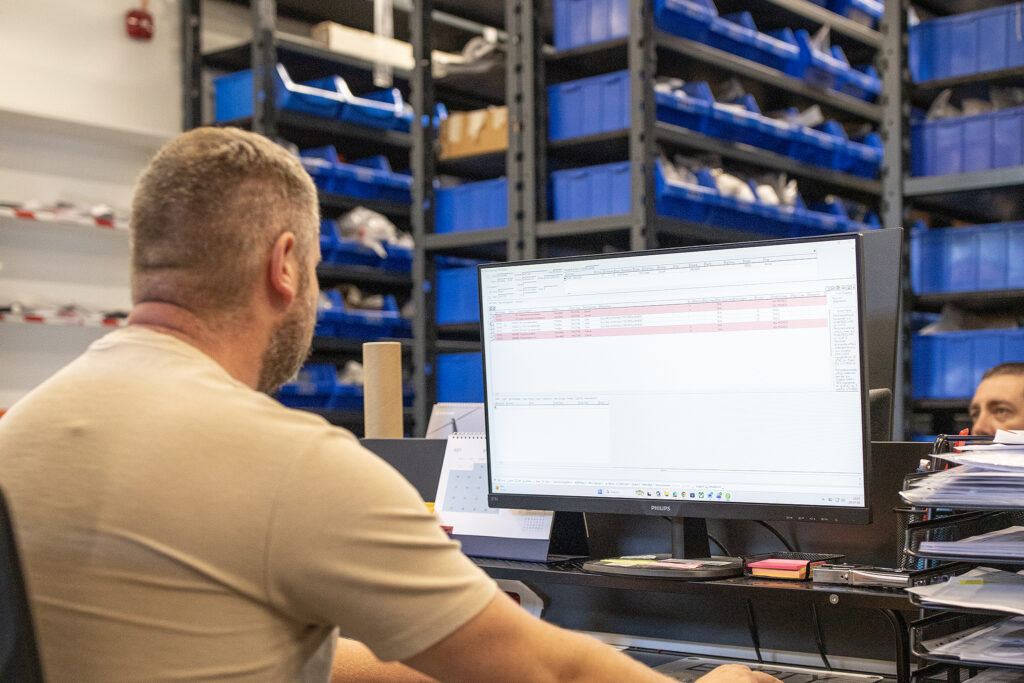
“Receiving of parts goes through Quantum, issuing of parts, work planning, as well as the financial side of the operation,” explains Đorđević.
Every movement of every part can be tracked within the system. The recorded data includes quantity, unit of measure (piece, gallon, liter), the receiving number generated in Quantum, a unique control number, lot number and expiry date. From the moment a part arrives in the warehouse until it is installed on an aircraft, its complete lifecycle can be traced, providing full visibility of its location, the Work Order it is reserved for, and the aircraft on which it was installed.
“Entering the expiry date at the time of receipt is extremely important so we can monitor it through Quantum,” Đorđević emphasises. “For materials that are opened, the opening date must also be recorded, because some products have to be discarded after a certain period due to their shelf-life limitations.”
The maintenance process begins with the creation of a Work Order, supported by routine work cards and, where required, non-routine work cards. Based on the defined maintenance tasks, mechanics submit requisitions for the required spare parts and consumable materials.
If the required parts are available in stock, they are reserved in the Quantum system and issued against the specific Work Order. For parts that are not available, the Purchasing Department initiates the procurement process after approval from the PPC department, while Logistics coordinates their import and delivery to the warehouse.
Upon arrival, parts undergo inspection of the accompanying aviation documentation, are recorded in the Quantum system, stored or reserved for a specific aircraft, and then issued to mechanics for installation in accordance with the applicable work cards.
Customs is a common bottleneck for almost every MRO organization in the region, but Prince Aviation has addressed this challenge by ensuring two customs agents are available 24 hours a day.
This is particularly important because almost all parts arrive from abroad: from Textron distribution centers in Wichita and Düsseldorf, from Dassault in France, from Boeing in the US or Europe, and other major aviation industry centers around the world.
Nothing in the warehouse is left to chance. The Purchasing Department defines minimum stock levels for every item, like lubricants, oils, sealants and other consumables, while Quantum automatically monitors inventory levels.
“Let’s say the minimum quantity for a particular sealant is ten units. As soon as stock reaches that level, the system generates an alert, signaling that a new order should be initiated,” explains Đorđević.
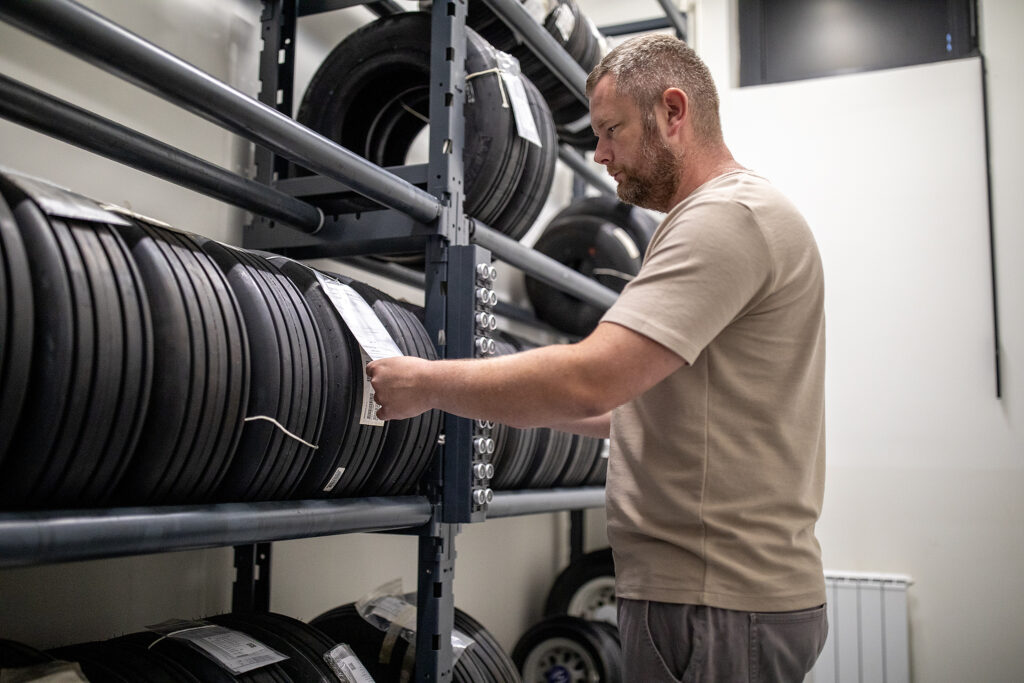
In addition to a wide range of consumable materials, the warehouse also contains the most valuable components, those that typically have the longest lead times and can cause the greatest delays during procurement. These include starter-generators, brakes, igniters, exciters, Check 1/2 kits for Williams engines, wheel assemblies, as well as a large inventory of aircraft tires supporting all aircraft types maintained by Prince Aviation:
Cessna 500/550/560, Cessna 525B, Cessna 560XL/XLS, Cessna 650, Cessna 501/551, Cessna 510, Cessna 525/525A, and Dassault Falcon.
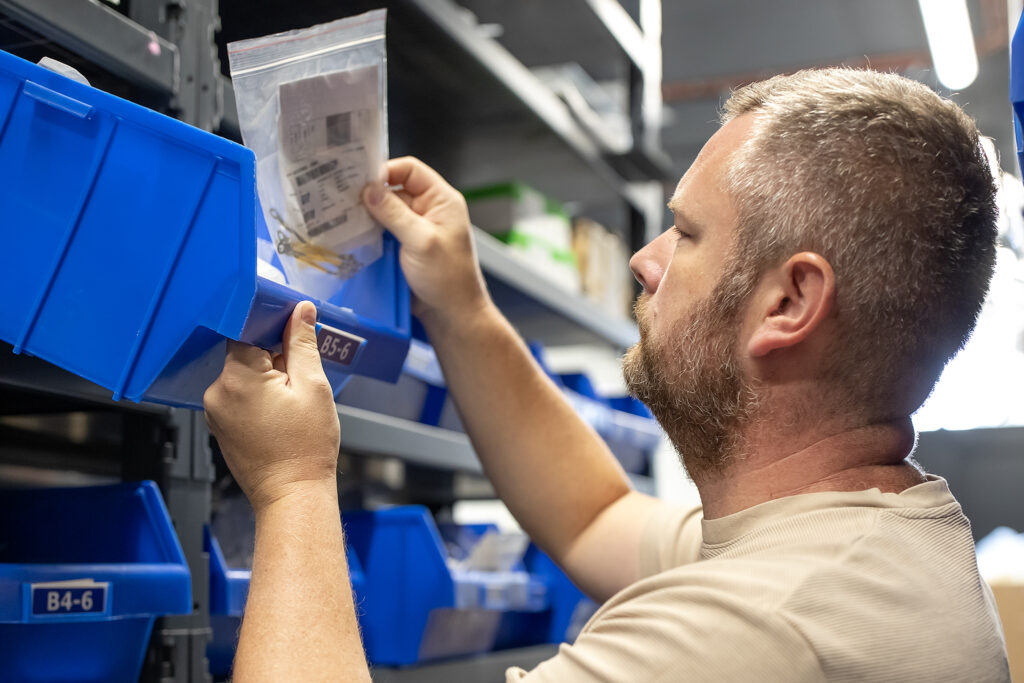
The warehouse also maintains a wide range of aircraft filters, seals and O-rings, gaskets, bearings, hardware, electrical consumables, lubricants, sealants, adhesives, specialty chemicals, fire extinguishers, life vests, as well as a large selection of aircraft bulbs for different aircraft types.
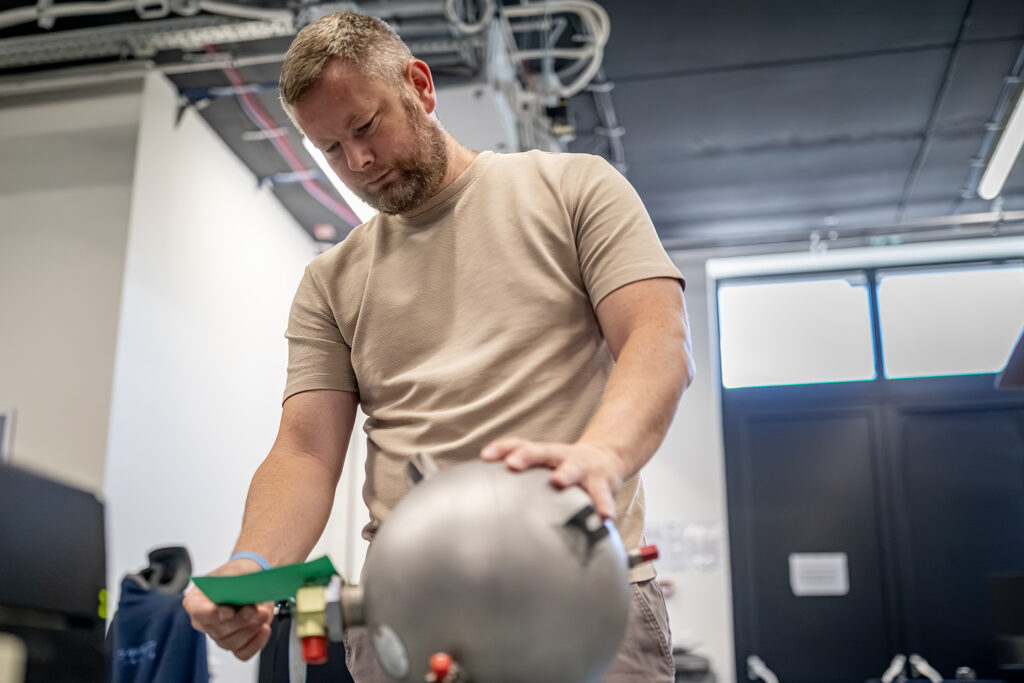
Batteries are also kept in stock, supported by Prince Aviation’s own battery maintenance workshop, ensuring that a serviceable replacement battery is available for installation whenever required.
Batteries are managed as rotable components, they are removed from the aircraft, processed through the workshop and returned to service as serviceable components. Aircraft wheels follow the same process through Prince Aviation’s wheel workshop.
“In aviation, a component removed from an aircraft cannot be installed on another aircraft until EASA Form 1 (or other adequate form or document FAA, TCCA, ANAC) has been issued for it. If it was removed as unserviceable, it goes through the workshop under a Work Order; if it was removed serviceable, its condition is verified. In both cases we issue an EASA Form 1, signed by a Component Certifying Staff in case that component is going thru the workshop or Aircraft Authorized Certifying Staff for that aircraft type for serviceable component,” says Đorđević. “Only then is the component confirmed as serviceable and given a new identification tag.”
That identification tag represents the foundation of the entire traceability system. It contains the Part Number, description, unique serial number, storage location and component status: REPAIRED, INSPECTED/TESTED, OVERHAULED or MODIFIED.
And what happens when a required part is not available on the shelf?
“Anything we currently do not have in stock can be delivered to our warehouse within two days at the latest,” says Đorđević. “There are situations where an urgent part, for example from Düsseldorf, arrives within just 24 hours.”
LATEST NEWS:
European MRO companies complete Cessna Citation XLS practical training at Prince Aviation
Prince Aviation has completed a practical Part 147 type training course for the Cessna 560 XL/XLS (Pratt &…
Prince Aviation hosts live demonstration of Gogo Galileo HDX in-flight connectivity in Belgrade
Six months after becoming an authorized Gogo dealer, Prince Aviation gave Southeast European business aircraft operators a hands-on…