
Prince Aviation CEO Srdjan Kragojevic: “We are capable of building hangars and buying equipment, but there is still no AI that can replace the technician.”
Speaking on “The Operators’ Approach to Maintenance” panel at the Biz Av Maintenance Conference in London, Kragojevic called…
Speaking on “The Operators’ Approach to Maintenance” panel at the Biz Av Maintenance Conference in London, Kragojevic called for predictability over speed, pressure at the right moment, honest quoting and an industry that cooperates rather than controls
Srđan Kragojević, Chief Executive Officer of Prince Aviation, today joined leading business aviation operators on stage at the Biz Av Maintenance Conference in London, arguing that the quality of aircraft maintenance should be measured by how predictable it is rather than by how fast or how cheap it is quoted.
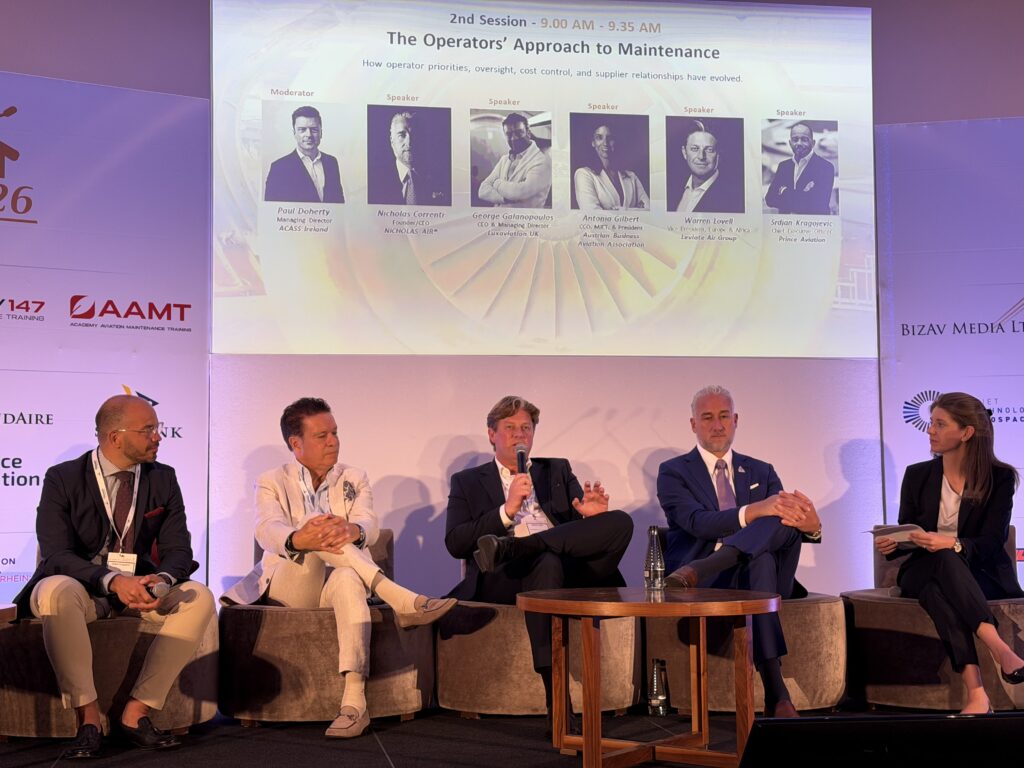
The panel, titled “The Operators’ Approach to Maintenance”, was moderated by Antonia Gilbert, CCO of MJET and President of the Austrian Business Aviation Association, and brought together Nicholas Correnti, Founder and CEO of NICHOLAS AIR, George Galanopoulos, CEO and Managing Director of Luxaviation UK, and Warren Lovell, Vice President Europe & Africa at Leviate Air Group. Kragojević was the only speaker representing both an operator and a Part 145 maintenance organisation, since Prince Aviation operates its own fleet and maintains third-party aircraft at its Belgrade base, with a recent addition of a Slovenian AOC for more flexible charter operations.
“Good maintenance is the one with no surprises,” Kragojević said. “It is maintenance that is arranged the right way at the beginning and delivered at the end in line with the customer’s expectation. If we quote three weeks and deliver in three weeks, that is quality maintenance – not maintenance that is quoted at ten days and delivered in four weeks. Predictability, and no surprises for the customer.”
“Good maintenance also means not piling up findings for the next visit,” he added. “If an aircraft is maintained well, it will not bring more and more surprises in the future, and everyone will be much more efficient the next time it comes in.”
Pressure belongs in the preparation phase
Asked how a Part 145 organisation copes with commercial pressure from owners who want their aircraft back on a given day, Kragojević said pressure itself is not the problem, timing is.
“Pressure is not an issue. Our business is full of pressure and if you are not able to work under pressure, this is not the industry for you,” he said. “The issue is when the pressure comes. The right time for pressure is the preparation process, when we are building the workscope. The wrong moment, for example, is when we find corrosion. You achieve nothing with pressure at that point. There is corrosion, the OEM has to be contacted, and it is a totally different process. Very often the owner or operator ends up killing the messenger.”
He identified three causes of delay that lie largely outside an MRO’s control: the global spare parts shortage, OEMs focused on new production rather than the aftermarket, and the shrinking pool of experienced engineers.
“As everybody in this room knows, with the parts shortage there is absolutely nothing you can do,” Kragojević said. “We should raise our voice to the OEMs. They need to be a little less about controlling the process and more about supporting it. Their main focus is on production, and there is not so much focus on the aftermarket.”
“The lack of experienced staff will be a big issue for this industry, and we can already see it with the number of aircraft arriving,” he continued. “We are capable of building hangars and buying equipment, but there is still no AI that can replace the technician.”
Finding the right balance between FAA and EASA approaches
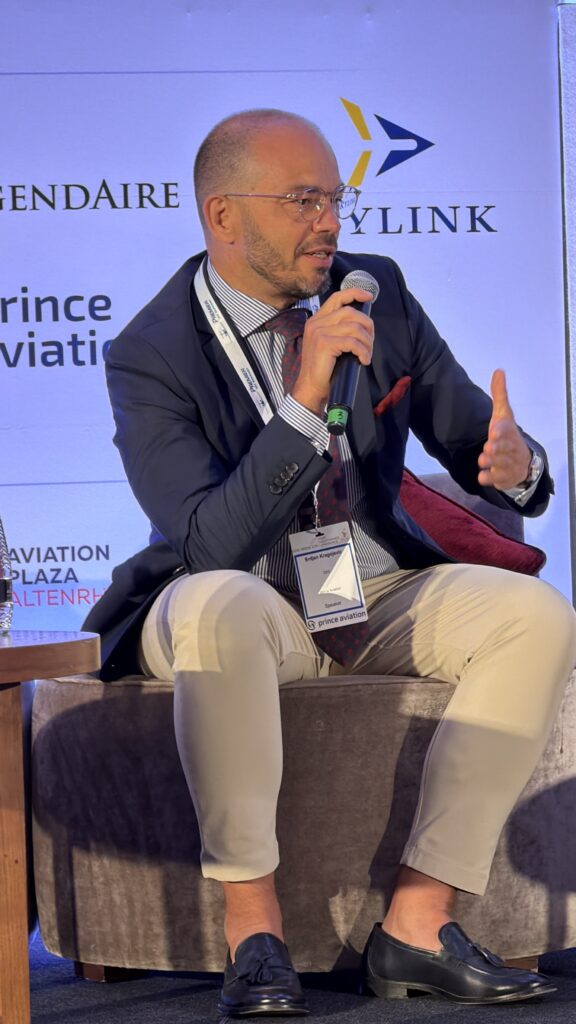
The discussion on FAA versus EASA compliance prompted Kragojević to share a recent example from Prince Aviation’s own hangar.
“We recently inducted a Citation M2 from the FAA register and the transition highlighted some significant differences between the two regulatory environments,” he said. “Certain records and operational information expected under the EASA system are not necessarily maintained or presented in the same way in the United States. When an aircraft moves between regulatory systems, those differences can create considerable additional work for the operator, CAMO and MRO.”
At the same time, Kragojević stressed the importance of keeping European regulation proportionate and closely aligned with the practical needs of the industry.
“EASA has built an extremely robust regulatory and safety framework, but as the regulatory environment continues to evolve, we need to ensure that new requirements remain proportionate, practical and focused on genuine safety and operational benefits. The US system can sometimes take a more pragmatic approach, while Europe provides a very comprehensive regulatory framework. There are strengths in both systems.”
He added: “Greater dialogue and harmonization between EASA, the FAA and the industry would benefit everyone, particularly as aircraft increasingly move between jurisdictions. The objective should not be less regulation, but smarter regulation, maintaining the highest safety standards while allowing qualified aviation professionals to focus their time and resources where they add the greatest value.”
Rethinking how maintenance is quoted
On the question of how MROs should quote downtimes to owners and operators, Kragojević argued that the traditional man-hour model no longer serves either side.
“The approach should be customised for each and every customer,” he said. “An MRO has one culture – this is the next slot – while operators want more availability. The MRO has to get out of its own way of thinking and be more in line with the operator and their request. The future MRO will be the one that has a certain carrot to shorten the time on the ground while still performing well. The current man-hour approach is a little obsolete. We need a different way of quoting maintenance, one that pushes maintenance to be more effective.”
He also called for closer cooperation between CAMOs and maintenance organisations. “The CAMO and the MRO are really divided at the moment; there is no proper communication. Long-term cooperation with an operator gives better results. Having an engineer or technical person from the operator in the MRO, tracking the whole process and being proactive, makes a real difference. Sometimes you wait a whole day before a finding is signed off simply because you cannot reach the owner. That kind of communication and overlap brings benefits to both sides.”
Kragojević was candid about the commercial reality of honest quoting. “If we quote four weeks and I tell you I can do it in four weeks, and then you go to another MRO that says two and a half weeks, many people will ask: can you match this? There are a lot of opportunists in our business. Smaller shops will promise the owner it will be shorter and cheaper. A mid-sized or large MRO with 250 people on the floor cannot compete with that on paper, but it can deliver. And how many CAMOs actually arrive with the documentation from the last inspection and the findings, so we know where to look and can prepare? That is the process we are lacking. I am telling you, being strictly honest in business is not always the smartest thing, but it is how we at Prince work.”
“Cooperate more”
Closing the panel, each speaker was asked to name the one thing they would change about business jet maintenance. While parts availability and regulatory harmonisation dominated the other answers, Kragojević focused on the direction of industry consolidation.
“I would like this consolidation to serve more than to control,” he said. “Everyone must understand that around us there are different companies and businesses that still need to grow and to live. If OEMs produce a hundred engines per year for a certain fleet, they need to produce another five for the rental pool. Operators and independent MROs are there to support their product, yes, we are competitors, but in a good way.” “As we say in our country: when your hand is closed, nothing gets in and nothing gets out. It has to be open,” Kragojević concluded. “We need to cooperate more than try to keep everything for ourselves.”
LATEST NEWS:
European MRO companies complete Cessna Citation XLS practical training at Prince Aviation
Prince Aviation has completed a practical Part 147 type training course for the Cessna 560 XL/XLS (Pratt &…
Prince Aviation hosts live demonstration of Gogo Galileo HDX in-flight connectivity in Belgrade
Six months after becoming an authorized Gogo dealer, Prince Aviation gave Southeast European business aircraft operators a hands-on…